Mrittunjoy’s forays into the world of science began in his school days at Montfort School, Delhi. Mrittunjoy represented the Delhi state at the 14th and 15th National Children’s Science Congress in Sikkim and Maharashtra respectively. His project of using woodlice as indicator organisms for a certain nutrient imbalance in the soil was selected as one of the top two projects among more than 600 projects from across the country in the 15h National Children’s Science Congress, and he represented the Republic of India at the First ASEAN Youth Science Summit in Manila, Philippines.
Entering St. Stephen’s College, Mrittunjoy came into contact with teachers and students from all across the country. He talks of one professor particularly in good light – Prof. Vikram Vyas, describing him as one of the greatest motivators in his path of pursuing Physics. He presented his first semester project (for his paper in Mechanics) on Analysis of Orbital Resonance, Kozai Mechanism and Multiple Star Systems using V-Python. After the first year of college, he had two summer projects and a summer school. The former two were in the field of Condensed Matter Physics in IIT Guwahati and USIC Delhi University, while the latter was the prestigious National Initiative on Undergraduate Science (NIUS) in the Tata Institute of Fundamental Research (TIFR).
At NIUS, he was selected for the project “Geometric Measure of Entangled States and their Applications” under Dr. Prasanta Panigrahi, one of India’s leading quantum information theorists. He spent two years working on this in the beautiful campus of IISER Kolkata near Kalyani (moved since then). Back in (St. Stephen’s) College, he led an initiative to engage with frontier areas of Physics, albeit in a rather curious way, in a society called Enthusiastic Physicists in Conversation (EPIC), a group that briefly had branches in Cambridge and Copenhagen as well.

Dr. Mrittunjoy Guha Majumdar has been actively involved in this area in collaboration with the Department of Science and Technology, Government of India. He has addressed school students in villages in Assam, Haryana and Delhi, and engaged with a number of University students, over the year. During his time in Cambridge, he also began a science blog called Chrience for Christ’s College, during his time as the MCR Academic Officer, and has been the Secretary of BlueSci, the Science Magazine of Cambridge University.
As part of governmental bodies such as the Department of Science and Technology (Government of India), think tanks such as the Cambridge University Science Policy and Exchange (CUSPE) and non-governmental organizations such as Scitya Foundation, Mrittunjoy has had close interactions with science policy and policy-makers. As part of CUSPE, he has come in contact with major fora and organizations such as the Westminster Forum, Center for Science and Policy (CSaP) and Cambridge Food Security Forum (CamFSF).
In 2014, he was selected among around 15 students from all over the world to pursue the Master of Advanced Studies (MASt) course in Cambridge, funded by the Nehru Trust and Christ’s College, Cambridge. He got a first in his majors and went on to secure a PhD position in the condensed matter physics division at Cavendish Laboratory. This time not only was he Nehru Trust scholar but also a Trinity Barlow Scholar, selected by Trinity College from a field spanning all fields and colleges of Cambridge, and a Hitachi CASE grant. He fondly remembers his time being a student of Prof. Malcolm Perry, guide to stalwarts like Dr. David Tong, for Quantum Field Theory and his interactions with luminaries like Prof. Wolfgang Ketterle, Prof. Peter Higgs and Prof. Venkatraman during his student life.
In Cambridge, two of his major research projects had been focused on ‘The Quantum Theory of Fluids’ and ‘Quantum Entanglement and Symmetries’. The former was done under Prof. Ben Gripaios (DAMTP and HEP-Cavendish Laboratory) and the latter under Prof. Crispin Barnes (Cavendish Laboratory) as part of his doctoral research.
In recent years, Dr. Mrittunjoy Guha Majumdar has expanded his research into some of the most cutting-edge and interdisciplinary frontiers of modern physics. His work now sits at the intersection of quantum information theory, artificial intelligence, and the philosophical foundations of reality, reflecting a rare synthesis of technical depth and conceptual ambition. As Chair of the Quantum Information and Intelligence Systems (QuIIS) group at Amrita Vishwa Vidyapeetham, his current pursuits include quantum machine learning (QML)—a rapidly evolving field that leverages quantum phenomena such as superposition and entanglement to process complex datasets beyond classical limits.
His recent research contributions explore novel architectures of entanglement and their applications, including work on hyperentanglement and hybrid entanglement for next-generation technologies such as quantum batteries and environmental sensing systems, pointing toward a future where quantum physics directly informs sustainability and energy innovation. In parallel, he has investigated deeper theoretical questions surrounding contextuality, holism, and reductionism, attempting to reconcile how local quantum behavior gives rise to global structures of reality. His work on vacuum fluctuation channels and quantum networks further advances the understanding of efficiency and security, key challenges in building scalable quantum communication systems.
What distinguishes a part of his recent trajectory is not merely technical sophistication, but a consistent effort to bridge quantum physics with broader epistemological frameworks. His work on quantum logic and transconstructive generative ideation integrates ideas from Indian knowledge systems with non-classical logic, proposing new ways of thinking about knowledge creation, cognition, and education in an age shaped by uncertainty and complexity. Alongside his research, Dr. Guha Majumdar has also been actively involved in India’s National Quantum Mission consultations, particularly in areas such as quantum error correction and mitigation, contributing to the strategic roadmap for the country’s quantum technological future.

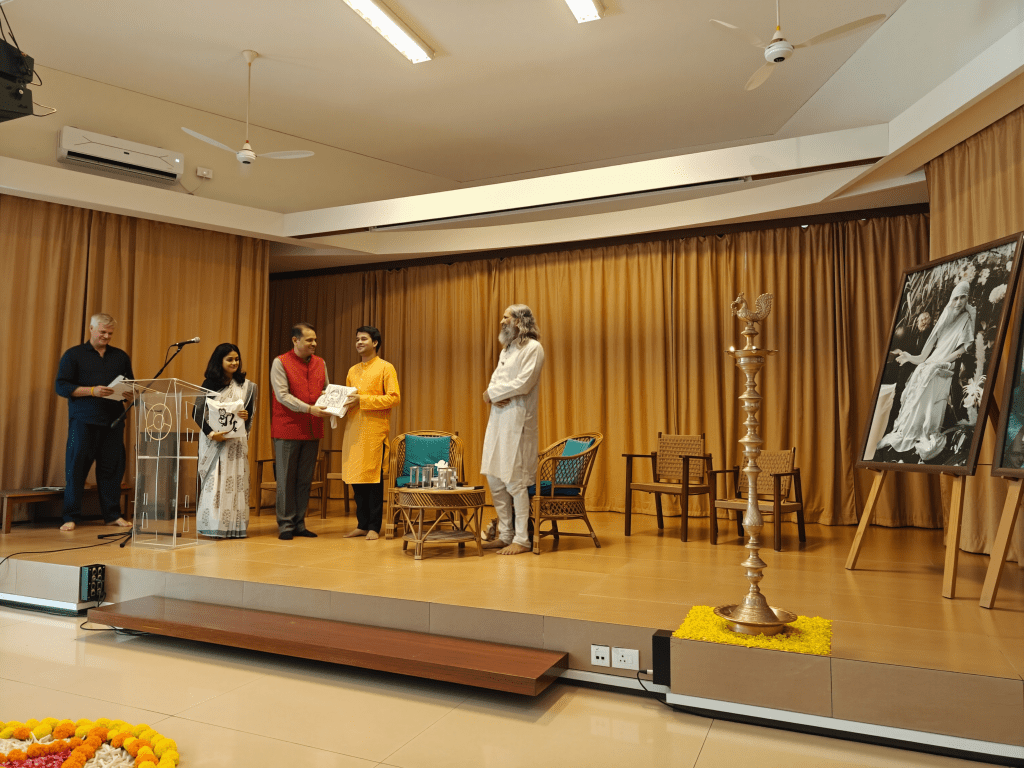
 Mrittunjoy Guha Majumdar