(This article by Dr. Mrittunjoy Guha Majumdar was published in Dream 2047, the flagship popular science magazine of the Department of Science and Technology, Government of India The edition carries the thoughts of Prof. Abhay Karandikar (Secretary, DST India), Prof. Shekhar Chintamani Mande (President, Indian National Science Academy) and Prof. Kalobaran Maiti (Director, IACS), along with other leading scientific voices on the quantum front.)
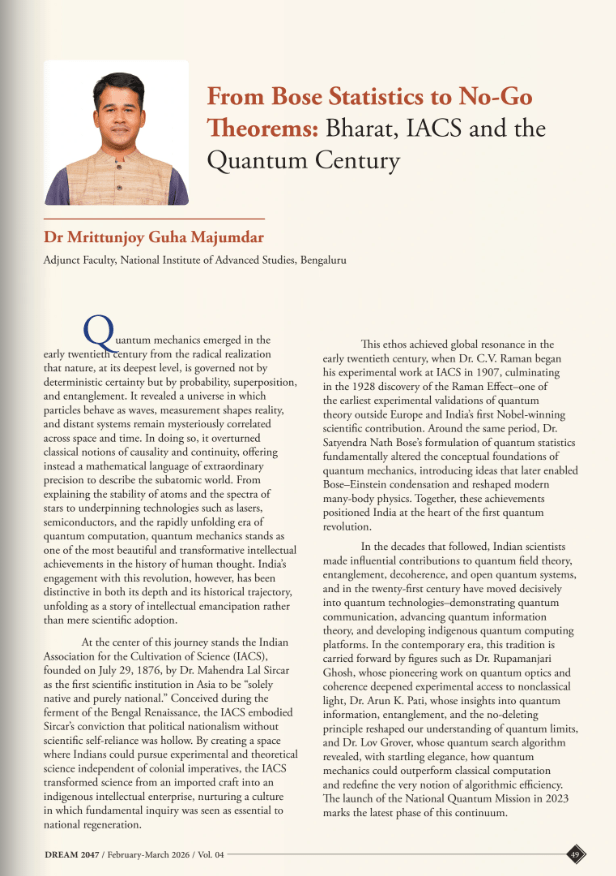
Quantum mechanics emerged in the early twentieth century from the radical realization that nature, at its deepest level, is governed not by deterministic certainty but by probability, superposition, and entanglement. It revealed a universe in which particles behave as waves, measurement shapes reality, and distant systems remain mysteriously correlated across space and time. In doing so, it overturned classical notions of causality and continuity, offering instead a mathematical language of extraordinary precision to describe the subatomic world. From explaining the stability of atoms and the spectra of stars to underpinning technologies such as lasers, semiconductors, and the rapidly unfolding era of quantum computation, quantum mechanics stands as one of the most beautiful and transformative intellectual achievements in the history of human thought. India’s engagement with this revolution, however, has been distinctive in both its depth and its historical trajectory, unfolding as a story of intellectual emancipation rather than mere scientific adoption. At the center of this journey stands the Indian Association for the Cultivation of Science (IACS), founded on July 29, 1876, by Dr. Mahendra Lal Sircar as the first scientific institution in Asia to be “solely native and purely national.” Conceived during the ferment of the Bengal Renaissance, the IACS embodied Sircar’s conviction that political nationalism without scientific self-reliance was hollow. By creating a space where Indians could pursue experimental and theoretical science independent of colonial imperatives, the IACS transformed science from an imported craft into an indigenous intellectual enterprise, nurturing a culture in which fundamental inquiry was seen as essential to national regeneration.
You can read more here.

 Mrittunjoy Guha Majumdar
Leave a comment